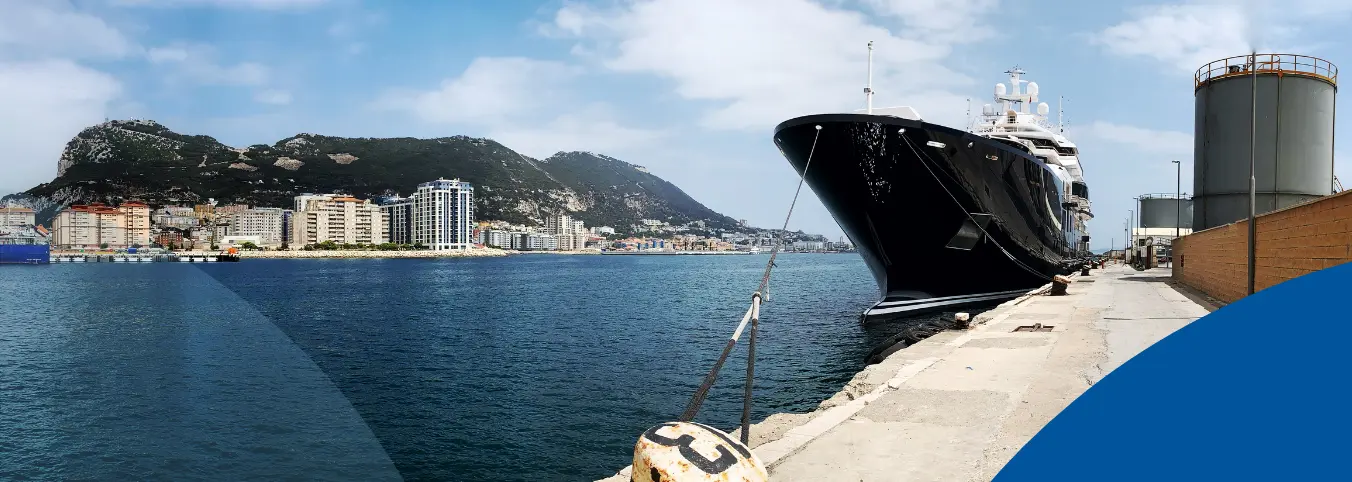
With more than 60,000 vessels transiting the Strait each year, Gibraltar has become the Mediterranean’s largest bunkering port and a bustling center of commerce. As World Fuel and fully owned subsidiary Gib Oil Limited complete exciting plans for expansion in Gibraltar, we showcase why this strategic port is the go-to destination for commercial shipping and luxury yachts alike.
The strategic significance of Gibraltar in global maritime trade
Gibraltar has long been recognized as one of the most strategically significant maritime locations in the world. Positioned at the gateway to the Mediterranean, where the Atlantic Ocean meets one of the busiest maritime corridors, Gibraltar plays a crucial role in global shipping. With approximately 60,000 vessels transiting the Strait of Gibraltar each year and around 240 million gross tons of vessel calls annually, the port has built a reputation for convenience and value for money.
Its ideal location has made Gibraltar the largest bunkering port in the Mediterranean, serving commercial shipping and large yachts with premium fueling, logistical support, and essential marine services. The Gibraltar Port Authority, established in 2005, has helped to ensure operational excellence, safety, and regulatory compliance. With services ranging from search and rescue operations to pollution prevention and bunkering regulation, the port continues to enhance its infrastructure and service offerings to meet the evolving demands of the maritime sector.
A growing presence in Gibraltar
World Fuel’s global footprint spans over 1,200 ports and 18 direct supply locations, with Gibraltar playing a pivotal role in its European and Mediterranean fuel supply chain. The company’s Western Arm Terminal provides direct access to high-quality marine fuels and lubricants, delivered via pipeline barge, or truck to accommodate different vessel requirements.
As part of its global bunkering network, World Fuel has expanded its capabilities in Gibraltar, positioning it as a key supply location for vessels of all types. With a firm foundation in fuel supply and logistics, World Fuel ensures seamless bunkering solutions for commercial shipping, cruise liners, and luxury yachts, offering a broad range of marine fuel and lubricant services via its fully owned subsidiary, Gib Oil Limited.
A new tank farm on the Western Arm positions Gib Oil as Gibraltar’s strategic fuel reserve. As the only operator with onshore tankage, and with sea-based import capacity, Gib Oil can supply essential services even if land-based routes are disrupted. This enhanced infrastructure is planned for completion by June 2025. Here is a summary of what to expect:
- Phase one of the new terminal includes three tanks—two large and one smaller—constructed on newly acquired prime real estate at the Western Arm.
- Future phases will expand the site to six tanks in total, maximising capacity within Gibraltar’s limited available space.
- The new terminal allows Gib Oil to increase throughput, enhance operational efficiency, and begin offering additional fuel grades.
- The facility is designed to support advanced environmental and safety standards, fully aligned with Gibraltar’s Bunkering Code of Practice.
“The new terminal marks a step change in our ability to serve customers at scale,” said Martin Xiberras, Finance Director at Gib Oil. “By expanding our storage capacity and building in the flexibility to handle alternative fuels like HVO and biofuels, we’re not just meeting today’s demand—we’re preparing Gibraltar to play a key role in the maritime energy transition. It’s a proud milestone for us locally and strategically important for shipping across the Strait.”
Gibraltar’s position as a leading bunkering hub is reinforced by several key advantages:
- Competitive fuel prices because of its tax-free status.
- High turnover and operational efficiency, keeping turnarounds quick.
- Competitive port dues, making it an economically viable choice.
- Strategic location, reducing deviation time for vessels.
- Rigorous regulatory framework, ensuring safety and environmental protection.
Bunkering operations in Gibraltar occur via barge when vessels anchor in Gibraltar Bay, with wharfside facilities available for those vessels requiring or preferring to receive bunkers while berthed. Since 2019, World Fuel has been operating time-chartered barges to deliver Marine Gasoil and Ultra Low Sulphur Diesel. The barge currently deployed in Gibraltar can supply up to 3.500 MT in a single trip.
Bunker grades available:
- Marine Gasoil ISO:8217 DMA 0.1%
- EN590 Diesel Max 10ppm Sulphur
- FAME (Fatty Acid Methyl Ester) Biodiesel and blends
- HVO (Hydrotreated Vegetable Oil)
Spotlight on Gib Oil: A trusted fuel supplier for commercial shipping and yachts
Gib Oil Limited has been a leading marine fuel supplier in Gibraltar for decades. The company’s onshore storage facilities and barge delivery network have long provided reliable and efficient fueling solutions for both commercial vessels and superyachts.
Marine fuel & lubricants for commercial shipping
For commercial shipping, Gib Oil offers:
- Strategic tankage capacity at the Western Arm, North Mole
- Dedicated bunker barge services
- Shell lubricants, ensuring superior engine performance and longevity
- Supply of Urea and Infineum additives
Gib Oil is the official distributor of Shell marine lubricants across Gibraltar, Spain, France, and Portugal. Supported by a logistics team based in Gibraltar, the company supplies across more than 60 ports, consistently ranking among Shell’s top 10 global distributors.
Luxury yacht solutions: Gibraltar as a premier yachting destination
Gibraltar is a well-established destination for superyacht owners, and demand has surged in recent years as the global yacht fleet expands. Gib Oil regularly handles maiden voyages for some of the world’s largest new builds, offering an unmatched range of services—including VAT-free marine fuel, waste oil disposal, spare parts, and crew support—within a single port call.
With three private marinas: Ocean Village, Marina Bay, and Queensway Quay Marina, yacht owners have access to luxury amenities and world-class marina services. The port’s Mid-Harbour Marina, completed in 2016, offers 500 meters of berthing facilities designed for superyachts, providing deep-water access and high security standards.
Gib Oil’s tailored solutions for yacht customers include:
- Marine Gasoil ISO:8217 DMA 0.1%
- EN590 Diesel Max 10ppm Sulphur
- FAME (Fatty Acid Methyl Ester) Biodiesel blends
- HVO (Hydrotreated Vegetable Oil)
- AdBlue / Urea supply
- Unleaded petrol/gasoline for tenders
- Jet A1 for onboard helicopters
Gibraltar’s future as a leading Maritime hub
As maritime regulations develop and the demand for a range of fuels and efficient bunkering solutions grows, Gibraltar is well-positioned to lead the next phase of maritime energy transition. With World Fuel and Gib Oil investing in infrastructure and supply capabilities, vessel operators can expect even greater flexibility, efficiency, and sustainability in their fueling operations.
The expansion of World Fuel’s Gibraltar operations in 2025 marks a significant milestone in the port’s development. Whether serving large commercial fleets, cruise liners, or luxury yachts, World Fuel remains committed to delivering unmatched reliability, competitive pricing, and world-class service in one of the busiest maritime corridors on the planet.
For more information about World Fuel in Gibraltar and to enquire about bunkering solutions, contact our team today.