
Rethinking solar power design
When businesses think of solar power, they often picture rows of south-facing panels tilted to capture maximum sunlight. That, at least, has been the general rule of thumb in the Northern Hemisphere: orient solar panels toward the south to maximize production over the year. This configuration works well for total energy yield, but not necessarily for financial performance.
In our recent webinar, we discussed how the smartest solar systems are now designed to maximize value, not just volume. By aligning generation with electricity price patterns and integrating storage, companies can significantly improve returns on investment.
Why smart design matters more than ever
As renewable adoption accelerates, energy strategy is shifting from simply installing as many solar panels as possible to optimizing performance under dynamic market conditions. Electricity pricing, demand charges, and carbon goals now interact in increasingly complex ways. That makes system design a financial decision as much as an engineering one. Design decisions determine whether solar is just a sustainability project or a high-return investment.
Understanding intraday pricing
Electricity prices don’t stay static throughout the day. On wholesale markets, intraday pricing reflects rapid fluctuations, sometimes changing every hour or even every five minutes, depending on demand, supply, and renewable generation levels. Prices typically peak in the mornings and evenings, when electricity demand is usually highest, but they can also turn negative during periods of excess renewable generation, such as midday on sunny summer days.
For businesses operating under time-of-use tariffs, these price swings directly impact the cost of electricity. Smart system design can help turn intraday volatility into a financial advantage.
The east–west array advantage
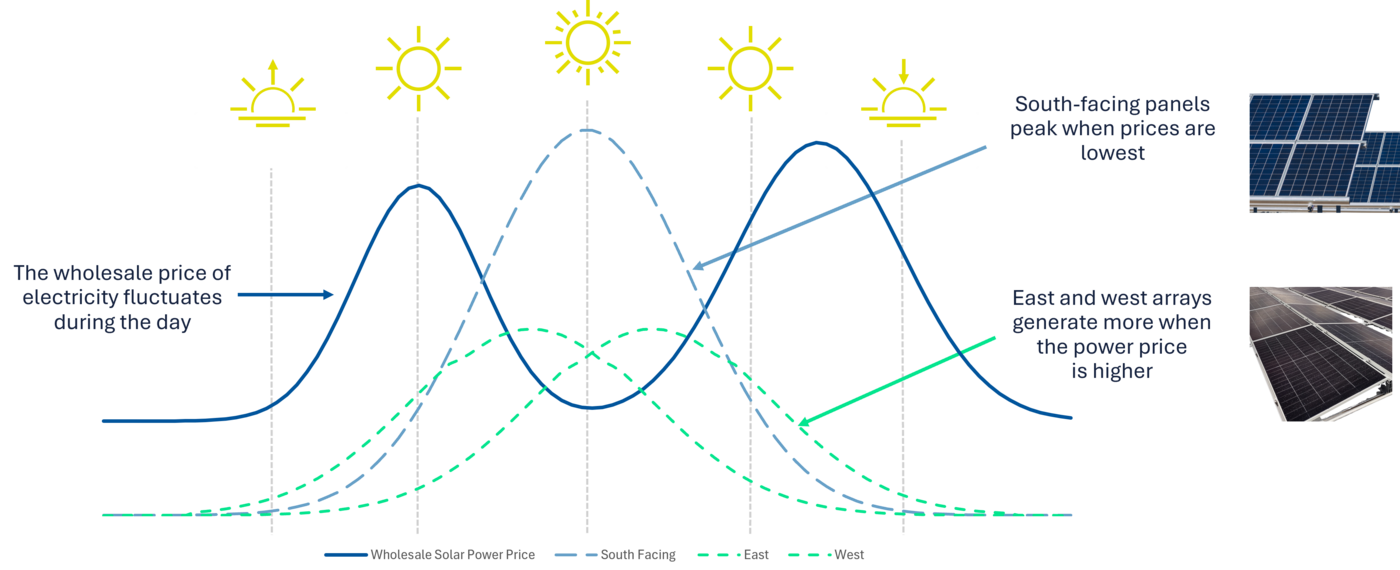
In traditional south-facing configurations, peak generation occurs around noon, when electricity prices are at their lowest.
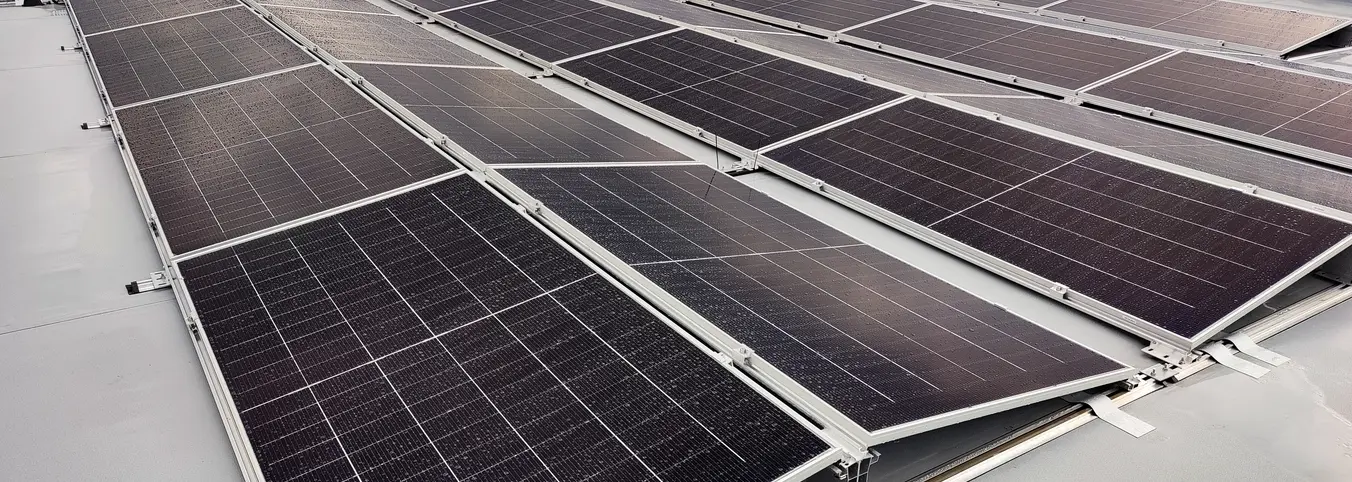
By contrast, an east–west setup spreads production more evenly across the day:
- With east-facing panels capturing early-morning sunlight when prices begin to rise.
- And west-facing panels that carry on generating late into the afternoon, aligning with high-value hours.
The result flattens your generation curve, and you benefit from more power when that power is more valuable - the result: steadier savings, higher returns, and better alignment with most operational energy needs.
Leveraging battery storage optimization
Battery Energy Storage Systems (BESS) take optimization a step further. They allow companies to store low-cost solar energy when it’s abundant, such as midday, and discharge it when grid prices are high, typically in the evening. The result is known as Time-of-Use Arbitrage.
Companies can also use storage systems for peak shaving, a practice that involves using stored energy (from a BESS) during periods of highest electricity demand. By supplying part of this demand from the battery instead of the grid, companies can reduce short-term demand spikes that trigger high-demand charges on commercial tariffs.
Together, these strategies lower both energy costs, by reducing the total amount of grid electricity consumed, and demand costs, by reducing the maximum power drawn from the grid at any one time. They also improve resilience during outages or periods of price surges.
Engineering solar systems for value
No two facilities are alike. Smart solar design is not about one “right” configuration; it is about aligning the system with each site’s consumption patterns and tariff structures. Projects need to be tailored to your company’s specific energy profile, operational needs, and financial goals.
- Businesses with high afternoon loads may favor east-west setups combined with BESS for enhanced time-of-use optimization.
- Facilities with intermittent load peaks benefit most from battery storage for demand management and peak shaving.
- Sites facing complex tariffs (e.g., blended demand and energy charges) can pair analytical modeling with engineering design to fine-tune array orientation, battery size, and control strategies.
Design decisions that drive ROI
Every kilowatt-hour of onsite solar has greater value when it’s generated or stored at the right time. By integrating east–west solar arrays and battery storage, businesses can align power output with market realities, capturing more savings from the same sunlight.
Early-stage engineering and feasibility assessments are critical. Understanding your site’s load profile, tariff structure, and operational goals allows expert design teams to model scenarios and choose configurations that deliver the highest return. Yet even a well-designed system can underperform if key risks are not addressed early.
Businesses should be aware of three common risks when considering a solar project:
- Poor system design or low-quality installation.
- Overestimated savings or unclear contract terms from developers.
- Changes to incentives or failing to act before incentives expire.
Designing a system that performs well on paper is not enough. That is why expert assessment is critical.
Solar energy experts
The energy experts at World Kinect can conduct an onsite solar assessment to help determine if onsite solar is right for your business and provide recommendations on the optimal configuration.
The assessment includes:
- Custom PV system design optimized for your site’s layout and energy usage.
- Hourly performance modeling to align solar generation with your actual demand and maximize ROI.
- A detailed financial analysis with clear insights on costs, savings, and payback.
If onsite solar works for your facility, World Kinect can help you get a project off the ground (or on your roof) from start to finish.
FAQs
What is the difference between south-facing and east-west solar panel arrays?
South-facing panels maximize midday generation, while east-west arrays spread generation across morning and afternoon, aligning better with peak electricity prices.
How does solar panel orientation affect energy savings?
Orientation impacts when energy is generated. East-west arrays can generate more during high-price periods, increasing the financial value of solar energy. Businesses that align their generation with high-value hours capture significantly greater savings from the same amount of sunlight.
Why aren’t south-facing panels always the best option?
Because south-facing layouts maximize total energy yield, but not necessarily financial value. East-west arrays often align better with a facility’s load curve and time-of-use pricing, producing energy when it’s worth more.
Can battery storage increase the value of solar energy?
Yes. Batteries allow businesses to store solar energy when prices are low and use it when grid prices are high, improving cost savings through time-of-use arbitrage.
What is peak shaving, and how does it work with solar and storage?
Peak shaving reduces demand charges by using stored solar energy during periods of highest electricity use, lowering overall energy bills.
How do tariff structures affect solar system design?
Commercial tariffs often combine energy (per kWh) and demand (per kW) charges. Smart design tailors system orientation and battery dispatch to minimize both, rather than focusing solely on total energy generation.
How do I know which solar system design is best for my site?
A feasibility study that considers your energy usage patterns, tariff structure, and available space can help determine the optimal system design.
Is it worth investing in solar tracking systems?
In some cases, yes. Tracking systems can increase energy yield by following the sun’s path, but they also add cost and complexity. ROI depends on location and energy goals.