A pivotal time for the UK nuclear industry
Nuclear energy currently supplies about 14%↗ of the UK’s electricity, providing steady, low-carbon energy alongside renewables like wind and solar. As the country pushes towards its Net Zero 2050 target↗, nuclear stands out as one of the few reliable sources of clean baseload power. Meanwhile, businesses in technology and heavy industry are accelerating electrification, driving clean power demand beyond today’s capacity.
However, the UK’s nuclear fleet is approaching a crossroads. By March 2030, the UK’s nuclear backbone will shrink to a single station – Sizewell B in Suffolk – creating a critical gap in energy supply. With most existing reactors approaching retirement and demand for clean electricity rising, replacing current capacity is essential if the UK is to meet its net zero commitments and maintain a resilient, decarbonised grid.
Still, the path forward is complex. Nuclear projects come with long construction timelines and high upfront costs, which have historically made private investment difficult. The government has thus introduced the Nuclear Regulated Asset Base (RAB) model↗ to help finance the next generation of plants. It is expected to create a more stable and financially viable pathway for new nuclear capacity.
Most of the UK’s nuclear fleet is nearing retirement just as demand for reliable low-carbon power is increasing. The RAB model is intended to reduce the financial risk of building new plants.
Understanding the Nuclear RAB scheme
The Regulated Asset Base model is the government’s new way of attracting private investment to finance large nuclear projects. This is a clear step-change from the previous Contracts for Difference model (CfD), where revenue only begins once electricity is supplied to the grid. The approach places a heavy risk on developers, making it slow and expensive to finance nuclear projects.
The RAB structure spreads costs over time, reduces financing risk, and creates more predictable returns. Instead of investors waiting until a plant generates power, the model allows them to receive a regulated return on investment during the construction phase. These payments come from a small nuclear RAB levy applied to all electricity bills.
The interim levy linked to this model came into effect on 1 December 2025 and may now be included on bills, adding a new layer of cost and uncertainty. For many businesses already dealing with rising non-commodity costs, understanding the UK nuclear levy and the RAB model is important as it begins to filter through contracts.
The RAB model is intended to reduce the financial risk of building new plants. However, for SMEs and corporate leaders, the levy raises practical questions about future bills, long-term cost exposure, and contract planning.
How the scheme works in practice
Once a project is designated as RAB-eligible, revenue is regulated by Ofgem, and payments between the project and energy suppliers are managed by the Low Carbon Contracts Company (LCCC). Three charges sit behind the scheme:
- The Interim Levy Rate (ILR) is the main quarterly charge.
- The Operational Costs Levy (OCL) is an annual fixed cost by MWh, covering the administrative running of the scheme.
- Reserve payments are set quarterly to provide protection if a supplier defaults, contributing to a Total Reserve Amount (TRA).
The framework introduces a balanced mechanism to manage volatility and build confidence. When electricity prices fall below the revenue threshold, suppliers make up the difference. When prices rise above that level, the project returns the surplus.
This isn’t just a financial safeguard; it’s a structural innovation that delivers investor certainty while protecting consumers from overpaying in high-price scenarios. However, suppliers contribute based on market share, and most will pass these charges through to business customers. Understanding this dynamic is essential for decision makers in an era of rising non-commodity costs.
How the Nuclear RAB levy affects your energy costs
The Nuclear RAB levy will appear during construction, which means non-commodity energy costs may now see an increase.
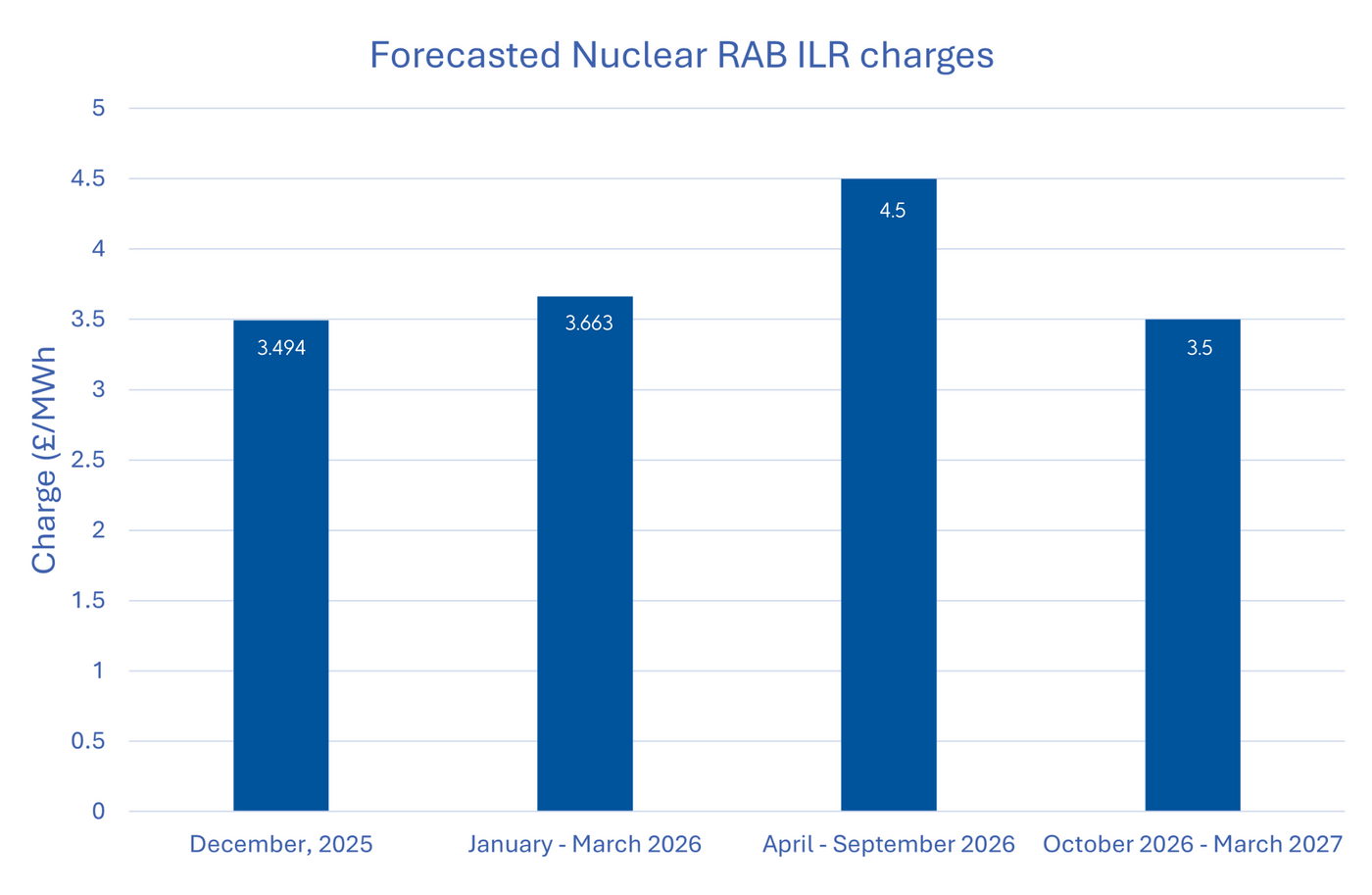
Nuclear RAB ILR Forecast (2025-2027)*
The government has confirmed the rates for Q1 2026, applying to all electricity bills:
- The Nuclear RAB Supplier Obligation Levy will be £3.663/MWh between 1 January 2026 and 31 March 2026.
- The Nuclear RAB Operational Levy will be £0.0028/MWh from 4 November 2025.
These initial levy rates are a starting point, but they are not the finish line. These are early indicators, subject to reconciliation as the market evolves.
While the charge itself is small, the impact depends on consumption. High-usage sites, such as manufacturing, will feel the effect more. For example, a large plant using around 50,000 MWh a year would see the Supplier Obligation Levy add roughly £183,000 a year to its electricity costs. A smaller site using a tenth of that would see a much lighter increase. The government is considering exemptions or compensation for Energy Intensive Industries (EIIs)↗ to limit the burden.
While short-term pressure on energy bills is inevitable, it’s essential to look beyond the immediate horizon. The long-term benefits are clear: spreading the cost reduces overall financing risk, nuclear output helps shield the market from gas volatility, and more domestic generation strengthens energy security.
The most direct impact of the RAB scheme will be on energy bills. Because businesses begin contributing to the cost of a nuclear project during construction, bills may see an increase from November.
Sizewell C as the first RAB project
Sizewell C↗ in Suffolk is the first project under the UK Nuclear RAB levy scheme, marking a major shift in energy management for businesses. It shares the design of Hinkley Point C and is expected to produce enough power for six million homes. It will also support supply chain growth and skilled jobs. Sizewell C’s role as the first RAB project marks a significant step in rebuilding the UK’s nuclear capacity.
What the levy means for your energy contract
The levy itself is only part of the picture. The impact depends on how your energy contract is structured.
- If you’re on a pass-through contract, the levy will be added automatically from December’s consumption.
- If you’re on a fixed contract, check your terms. Many suppliers can amend prices when government charges change. Some may hold the cost until renewal; others may pass it through sooner.
- If your business has an EII exemption, the levy won’t apply while your certificate is active.
A quick review now can help prevent surprises and give you time to adjust budgets or procurement plans.
How the levy affects your organisation depends on the type of contract you’re on. Review your contract position now to prevent unexpected charges later.
How energy brokers can help you navigate the Nuclear RAB changes
The Nuclear RAB scheme is a step toward a lower-carbon, more secure energy system, but it does bring new costs and uncertainty.
A good broker can help you stay on top of levy changes, interpret supplier updates, and explain how each charge shows up on your bill. They can also review your contract terms, flag exposure to pass-through costs, and help you compare structures before you commit.
For larger organisations, brokers can provide longer-range support too, from modelling the levy’s impact across multi-site portfolios, to managing forecasts and checking whether EII exemptions apply.
How World Kinect can support your business
World Kinect works with organisations that need clarity and control as the energy landscape evolves. The arrival of the Nuclear RAB levy adds one more variable to manage, so having expert insight can make a measurable difference to cost certainty and risk.
Our team follows regulatory updates in real-time and translates them into clear guidance on what each change means for your contract and future budgets. This helps you stay ahead of supplier pass-throughs rather than simply reacting when costs appear.
World Kinect also reviews how your contract is structured, where you may be exposed to non-commodity increases, and where you have room to protect costs. For pass-through agreements, we can calculate the levy’s projected impact; for fixed deals, we help assess the likelihood of mid-term adjustments.
For multi-site and high-usage organisations, we can provide consumption modelling so you can see how RAB costs spread across your estate. If you’re eligible for the EII exemption, we check documentation and make sure everything is in place.
Beyond the levy, World Kinect helps businesses strengthen wider resilience through market intelligence, procurement support, cost reporting, and sustainability planning. The aim is simple: to give you the information and confidence you need to plan ahead and manage exposure in a changing market. Reach out to our Energy Services team today for a free consulting session.
* The chart presents the forecasted Interim Levy Rate (ILR) charges under the UK's Nuclear Regulated Asset Key Points:
- Dec 2025: £3.494/MWh (initial confirmed rate)
- Jan Mar 2026: £3.663/MWh (confirmed increase)
- Apr Sep 2026: ~£4.50/MWh (summer forecast)
- Oct 2026 Mar 2027: ~£3.50/MWh (winter forecast)
References:
[1] Low Carbon Contracts Company (LCCC) (2025, November 7). Nuclear Regulated Asset Based Bulletin
[2] Open Government Licence (2025, April). Energy Intensive Industries (EIIs).
[3] UK Government Department for Business, Energy & Industrial Strategy (2021, October 26). Future funding for nuclear plants - An explanation of the Regulated Asset Base (RAB) model option.
[4] Crown Gas and Power (2025). Nuclear Regulated Asset Base - RAB Levy