
Water bills for businesses across England and Wales are set to rise again in 2026-27, but less sharply than last year. For small and medium businesses (SMBs) already facing tight margins and economic uncertainty, understanding these changes is critical.
How much are water bills increasing?
On 1 April 2026, business water suppliers will increase their annual water rates. The average combined household water and sewerage bill is expected to reach £639 in 2026–27↗, up £33 year on year. Commercial customers usually pay more and face greater variation based on usage, effluent volume, meter size, and drainage.
Ofwat states this year’s increase is far below the 27% rise in 2025–26↗, but notes increases will persist as part of the PR24 settlement. For SMBs with customer-facing sites or operations, even small increases impact overheads.
Why are prices rising?
These bill adjustments are directly tied to Ofwat's PR24 price review, with £104 billion investment↗ being delivered by water companies through 2030 to address structural and regulatory pressures.
Several key outcomes include:
- Ten million smart meters
- Nine new reservoirs
- Nine large-scale transfer projects
- A 17% further reduction in leakage
- More than 45% fewer storm overflow spills compared with 2021 levels
Higher charges support infrastructure and performance improvements: boosting resilience, reducing environmental harm, and ensuring supply security.
These upgrades are intended to reduce incidents that cause operational downtime, such as supply disruptions, pressure issues, or wastewater failures, but they also represent cost pass‑throughs that are increasingly visible on bills.
While the 2026–27 increase is smaller than last year, it should not be seen as a return to stable pricing. Ofwat’s PR24 pathway means water costs will likely remain under upward pressure through the decade, even with annual variability.
What does this mean for SMBs?
1. Consumption control is key as prices rise moderately through 2030
As costs rise, each saved cubic metre counts. SMBs with metered supply or effluent charges can offset some increases by reducing use. Leak detection, usage profiling, efficient equipment, and tighter site-level tracking matter, especially for businesses unfamiliar with their water usage patterns.
2. Variable impact by region
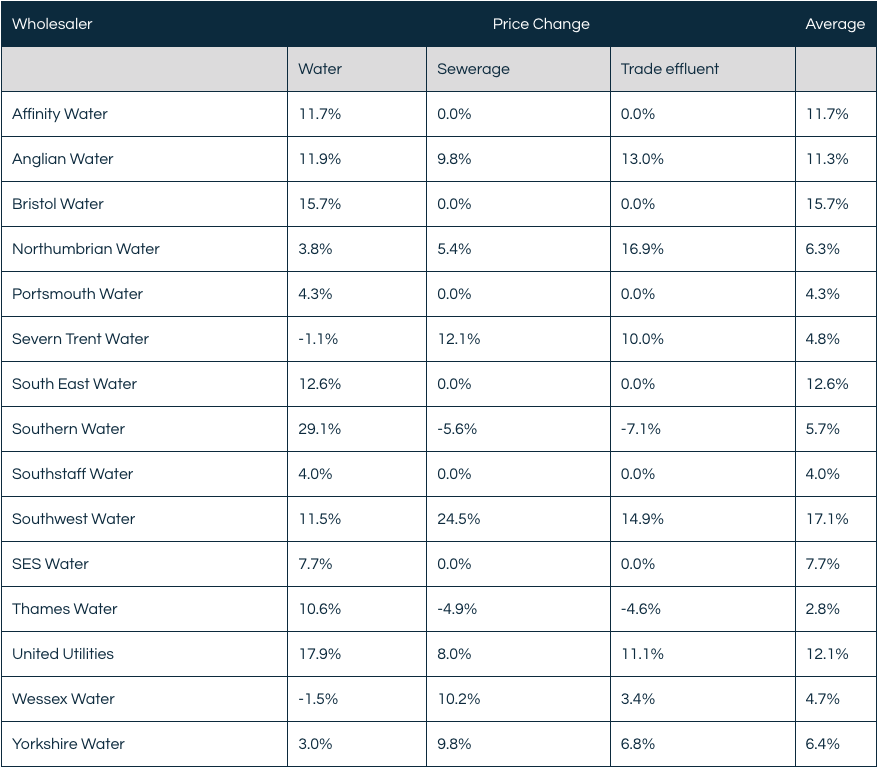
Businesses operating across multiple locations should not assume water inflation is broadly the same everywhere. Water Plus’s 2026–27 wholesaler update↗ shows substantial variation in average changes by region.
Why regional supply pressures matter
Regional price differences are not arbitrary. They reflect different operational and infrastructure pressures across wholesale areas, including water stress, asset condition, and the scale of investment required to improve resilience.
For instance, in the Anglian Water region, long-term supply pressure is a defining issue. Anglian Water serves the driest region in the UK while also supporting a fast-growing population. That combination increases the need for investment in resilience, resource planning, and infrastructure upgrades. For businesses in the region, the case for higher water investment is tied directly to future supply security, not only environmental compliance.
The South East also faces major supply challenges. It is among the most water-stressed UK regions and requires new infrastructure to keep supplies reliable. In January 2026, Ofwat began investigating South East Water after repeated outages, some affecting over 30,000 homes, and a major outage in Tunbridge Wells in late 2025. These incidents show why resilience investment affects pricing.
3. The growing importance of Automated Meter Reading (AMR) and smart water management
As prices rise over multiple years, businesses need better visibility over how water is actually being used. That is where AMR and broader smart water management become more useful. Rather than relying on periodic invoice reviews, businesses can use better data to identify unexpected consumption, spot leaks earlier, understand out-of-hours usage, and make more informed decisions about efficiency measures.
Switching to AMR can revolutionise the way your business manages its water usage:
- Real-time insights & alerts: Monitor water usage in 15-minute intervals, detect leaks, and address inefficiencies promptly with automated alerts.
- Cost savings & accurate billing: Eliminate manual errors, ensure accurate billing based on actual usage, and reduce disputes and overcharges.
- Sustainability & efficiency: Optimise water usage to reduce waste and carbon footprint, while freeing staff from manual readings with easy, non-disruptive installation.
What SMBs can do right now?
Review water usage, tariffs, and ways to increase water efficiency with expert help. The first step is to review water usage and billing structure in more detail. You want to understand whether your costs are mainly driven by consumption, wastewater returns, drainage assumptions, meter size, or contract setup. When prices are rising, hidden inefficiencies or billing issues become more expensive to leave unaddressed.
World Kinect has a proven track record of delivering significant utility savings and providing expert support to businesses of all sizes. We can help you get started with a free consultation to review your current water contract.
Could you unlock lower tariffs?
By analysing your current water usage and supplier rates, you can also identify better tariffs that match your business needs. (On average, our clients save over £11,500 annually* through our services.)
Have you been overpaying?
Billing errors are surprisingly common, with as many as 1 in 8 water bills containing mistakes**. (Our audits have helped businesses recover thousands of pounds in refunds for overcharges.)
Businesses with multiple sites can benchmark their business against regional averages.
Where businesses operate across several locations, comparing sites by region can reveal where charges are moving fastest and where consumption patterns appear out of line with peers or internal expectations. This can help prioritise action and improve budget forecasting.
Conduct a water audit and assess whether AMR would improve visibility.
As costs climb, usage insight yields stronger returns by revealing waste, leaks, and savings opportunities.
Approach procurement strategically.
Switching retailers alone cannot avoid wholesale increases. The real value lies in contract clarity, tariff expertise, and cost recovery. For SMBS, the key is not stopping price rises, but making spending more controlled and visible.
Get support from experts at World Kinect
World Kinect can help your business reduce your water supply costs in a number of ways. Our experts have decades of experience in utility procurement and management. From procurement to water audits and AMR installation, we offer end-to-end support.
Contact us today to design an effective water management strategy.